Drawer Guide Roller: A Comprehensive Guide
Drawer guide rollers are essential components, facilitating smooth drawer movement within furniture; they come in diverse types,
like roller and ball-bearing slides, each offering unique advantages for various applications and budgets.
Drawer guide rollers represent a fundamental element in modern furniture design, quietly enabling the effortless opening and closing of drawers we often take for granted. These seemingly simple mechanisms are crucial for functionality and user experience, impacting everything from kitchen cabinets to bedroom dressers. Understanding their purpose and variations is key for both furniture manufacturers and DIY enthusiasts.
Historically, drawers relied on simple wooden runners, often resulting in friction and sticking. The introduction of drawer guide rollers, and later ball bearing slides, revolutionized drawer movement, offering significantly reduced friction and increased load capacity; Today, choosing the right type of slide – whether roller slides with nylon or steel rollers, or the more durable ball bearing slides – depends on factors like budget, weight requirements, and desired smoothness of operation.
What are Drawer Guide Rollers?
Drawer guide rollers are the mechanical components that allow drawers to slide in and out of furniture with ease. Essentially, they are the interface between the stationary cabinet frame and the moving drawer box. They come in two primary forms: roller slides and ball bearing slides, each employing a different method to reduce friction.
Roller slides utilize small nylon or steel rollers attached to the drawer side, which run along a track or rail fixed to the cabinet. These are generally more cost-effective. Conversely, ball bearing slides use hardened steel balls within a raceway to achieve smoother, more durable movement. Both types are available in various mounting configurations – side mount, undermount, and center mount – to suit different design needs. The length of guide rails typically ranges around 20 inches, though longer options up to 50 inches exist.
The Core Function of Drawer Guide Rollers
The primary function of drawer guide rollers is to transform linear motion into smooth, controlled drawer movement. They minimize friction, enabling effortless opening and closing, even with substantial load capacity. This is achieved through either the rolling action of nylon or steel rollers along a track, or the gliding of ball bearings within a raceway.
Beyond simple movement, rollers contribute to drawer stability, preventing tilting or misalignment. Different types offer varying degrees of extension – full-extension for complete access, or three-quarter extension for a balance of access and space saving. Furthermore, features like soft-close mechanisms utilize the roller system to gently decelerate drawer closure, enhancing user experience and preventing damage.
Types of Drawer Slides & Rollers
Drawer slides broadly fall into roller slides and ball bearing slides, differing in mechanics and durability; choices depend on budget and desired performance.
Roller Slides vs. Ball Bearing Slides
Roller slides utilize wheels, traditionally affixed to the bottom edge of the drawer box, offering a cost-effective solution for furniture drawers. They are generally simpler in design and more affordable than their counterparts. However, ball bearing slides employ stainless steel ball bearings, providing superior durability and smoother operation, especially under heavier loads.
The choice between the two hinges on application and budget. While roller slides are suitable for lighter-duty drawers, ball bearing slides excel in demanding scenarios requiring robust performance and longevity; Ball bearing slides often support longer lengths, reaching up to 50 inches, compared to the typical 20-inch roller slide rails. Ultimately, the best option depends on the specific needs of the project.
Nylon Rollers: Advantages and Applications
Nylon rollers represent a popular choice within roller slides, prized for their inherent longevity and smooth operational characteristics. These rollers offer a balance between performance and cost, making them ideal for a wide range of furniture applications. Prime-Line specifically highlights nylon rollers for their extended lifespan, contributing to the overall durability of the drawer slide system.
Typically found in traditional furniture drawers, nylon rollers are well-suited for lighter to medium-duty applications where extreme load capacity isn’t a primary concern. They provide quiet movement and reduce wear on both the drawer and the surrounding cabinet structure. Their affordability makes them a practical solution for budget-conscious projects, delivering reliable performance without a significant investment.
Steel Rollers: Durability and Load Capacity
Steel rollers, often utilized in roller slides, distinguish themselves through exceptional durability and a heightened capacity to bear substantial loads. While nylon rollers offer a cost-effective solution, steel provides a robust alternative for demanding applications. These rollers excel in environments requiring consistent, heavy-duty performance, ensuring long-term reliability.
Compared to plastic alternatives, steel rollers demonstrate superior resistance to wear and tear, minimizing the need for frequent replacements. This makes them particularly suitable for drawers containing heavier items or those subjected to frequent use. Although potentially more expensive upfront, the extended lifespan and increased load-bearing capabilities of steel rollers often translate to long-term cost savings and enhanced functionality.

Mounting Options for Drawer Slides
Drawer slides offer varied mounting styles – side, undermount, and center – impacting accessibility and aesthetics; selecting the right option
depends on the specific furniture design and desired functionality.
Side Mount Drawer Slides
Side mount drawer slides represent a common and straightforward installation method, attaching to the sides of both the drawer box and the cabinet carcass. This configuration is generally considered the easiest to install, making it a popular choice for both DIY enthusiasts and professional cabinet makers.
These slides are typically fixed to the bottom edge of the drawer box, offering good support for lighter to medium-duty applications. They are versatile and suitable for a wide range of furniture, including bedrooms, kitchens, and offices. However, side mount slides can sometimes exhibit a slight wobble or reduced stability compared to other mounting options, particularly with heavier loads.
The accessibility for installation and relatively lower cost contribute to their widespread use, making them a practical solution for many drawer slide needs. They are available in both roller and ball-bearing varieties, offering options for varying levels of smoothness and durability;
Undermount Drawer Slides
Undermount drawer slides offer a sleek, concealed appearance by mounting beneath the drawer box, creating a cleaner aesthetic as they are not visible from the side. This mounting style provides enhanced stability and a more robust feel compared to side mount options, particularly beneficial for heavier drawers or frequent use.
Installation requires precise alignment, as the slides attach to the underside of the drawer and within the cabinet, demanding careful measurement and execution. They generally offer full-extension capabilities, allowing complete access to the drawer’s contents.
Undermount slides are often favored in modern kitchen and furniture designs where a minimalist look is desired. While potentially more challenging to install initially, the improved functionality and concealed design make them a worthwhile investment for many applications. Both roller and ball-bearing versions are available.
Center Mount Drawer Slides
Center mount drawer slides distinguish themselves by attaching to the center of the drawer box, rather than the sides, offering unique advantages in specific scenarios. This configuration is particularly useful for drawers with limited side clearance or when reinforcing the drawer’s structural integrity is paramount. They distribute weight more evenly, making them suitable for heavier loads.
Installation can be more complex than side or undermount slides, requiring accurate centering and secure attachment points. However, the resulting stability and load-bearing capacity are often worth the extra effort. Center mount slides are frequently found in industrial applications or heavy-duty furniture.
While less common in residential settings, they provide a robust solution where traditional mounting methods are impractical. Both roller and ball-bearing options exist, catering to varying budget and performance requirements.
Features & Functionality
Drawer slides exhibit diverse features, including full, three-quarter extension, locking, soft-close, and push-to-open mechanisms, enhancing usability and convenience for varied applications.
Full-Extension Drawer Slides
Full-extension drawer slides represent a premium functionality, allowing the drawer to be pulled out completely, providing unobstructed access to the entire drawer interior. This is particularly beneficial for larger drawers or those requiring access to items stored at the very back.
Unlike three-quarter extension slides, full-extension versions maximize usable space and improve organization. They are commonly utilized in kitchens for pot and pan storage, bedrooms for clothing access, and workshops for tool organization.
These slides often incorporate features like soft-close mechanisms for quiet operation and can be constructed from durable materials like steel or incorporate robust nylon rollers to support substantial weight. Choosing full-extension slides enhances both the convenience and practicality of drawer systems.
Three-Quarter Extension Drawer Slides
Three-quarter extension drawer slides offer a balance between accessibility and cost-effectiveness. These slides allow the drawer to extend approximately three-quarters of its total length, providing substantial access to most of the drawer’s contents. While not offering complete visibility like full-extension slides, they remain a popular choice for many applications.
They are frequently found in standard furniture construction, offering a reliable and affordable solution for everyday drawer functionality. This type is suitable for drawers where full access isn’t critical, such as clothing drawers or general storage.
Both steel rollers and nylon rollers can be utilized in three-quarter extension slides, impacting durability and load capacity. They represent a practical compromise between full access and budget constraints.
Soft-Close Drawer Slides
Soft-close drawer slides represent a premium feature, enhancing user experience and preventing damage to furniture. These slides incorporate a damping mechanism, typically near the end of the drawer’s travel, which gently decelerates the drawer’s closing speed. This prevents slamming and reduces wear and tear on both the drawer and the cabinet.
They are increasingly popular in kitchens and bathrooms, where quiet operation is particularly valued. While generally more expensive than standard slides, the added convenience and protection they offer make them a worthwhile investment for many.
Ball bearing slides are commonly paired with soft-close mechanisms, providing both smooth operation and controlled closure. Both roller slides and ball bearing slides can be equipped with this feature.

Materials and Durability
Drawer slides utilize materials like stainless steel for robust longevity, while plastic rollers offer cost-effectiveness; wear resistance varies based on material and load.
Stainless Steel Drawer Slides
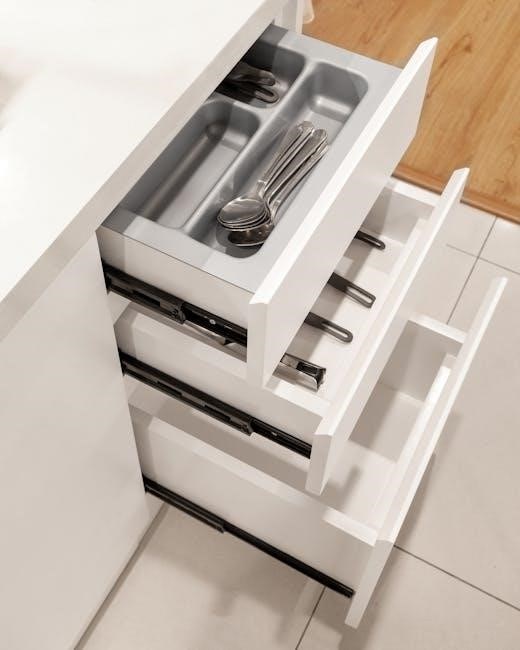
Stainless steel drawer slides represent a premium option, renowned for their exceptional durability and resistance to corrosion. The use of stainless steel, particularly in conjunction with ball bearings, significantly extends the lifespan of the slides, making them ideal for demanding applications and environments prone to moisture.
Compared to slides utilizing plastic rollers, stainless steel offers superior load capacity and can withstand heavier drawers without compromising smooth operation. This material choice is particularly beneficial in kitchens and bathrooms where humidity is a concern, preventing rust and ensuring long-term functionality.
While generally more expensive upfront, the longevity and reliability of stainless steel slides often translate to a lower total cost of ownership, reducing the need for frequent replacements. They are a worthwhile investment for high-quality furniture and applications requiring robust performance.
Plastic Rollers in Drawer Slides
Plastic rollers, often nylon, are a common feature in more budget-friendly drawer slides. They provide a cost-effective solution for lighter-duty applications, such as drawers in bedrooms or offices where heavy loads aren’t expected. Prime-Line offers examples of drawer rollers utilizing nylon for longevity.
While not as durable as steel rollers or ball-bearing slides, plastic rollers offer smooth operation and are suitable for frequent use in less demanding scenarios. However, they may exhibit wear and tear over time, particularly with heavier loads or rough handling.

The primary advantage of plastic rollers lies in their affordability and quiet operation. They are a viable option when cost is a significant factor and extreme durability isn’t a necessity. Regular cleaning can help extend their lifespan, but eventual replacement is often required.
Longevity and Wear Resistance
Drawer guide roller lifespan hinges on material and load. Stainless steel ball bearings demonstrably outperform plastic rollers in durability, resisting wear from consistent use and heavier weights. However, even steel components aren’t immune to degradation over extended periods.
Factors like frequency of drawer opening/closing, the weight of contents, and environmental conditions (humidity, dust) all contribute to wear. Regular cleaning and lubrication are crucial for maximizing longevity, reducing friction, and preventing premature failure.
Roller slides, generally, have a shorter lifespan than ball bearing slides. Monitoring for stiffness or noise signals impending issues. Proactive maintenance and timely replacement of worn rollers ensure continued smooth drawer operation and prevent more significant furniture damage.
Choosing the Right Roller for Your Needs
Selecting drawer guide rollers requires balancing load capacity, budget, and the specific application; consider drawer weight, frequency of use, and desired smoothness.
Load Capacity Considerations
Determining the appropriate load capacity is paramount when selecting drawer guide rollers. Heavier drawers, or those frequently storing dense items, necessitate robust slides capable of supporting significant weight without compromising smooth operation or longevity. Steel rollers generally offer superior load capacity compared to nylon rollers, making them ideal for demanding applications like kitchen pantries or tool chests.
Conversely, lighter-duty drawers, such as those in bedrooms or offices, may adequately function with nylon rollers, providing a cost-effective solution. Exceeding a slide’s load capacity can lead to premature wear, bending, or even complete failure, resulting in frustrating drawer malfunctions. Always consult the manufacturer’s specifications to ascertain the maximum weight rating before installation, ensuring reliable performance for years to come.
Budget-Friendly Options
For cost-conscious projects, roller slides generally represent the most budget-friendly option in drawer guide rollers. Utilizing nylon rollers further reduces expenses compared to slides featuring steel rollers or ball bearings. While nylon rollers may not possess the same durability or load capacity as their counterparts, they are perfectly suitable for lighter-duty drawers in applications like bedrooms or closets.
However, compromising excessively on quality can lead to premature failure and the need for replacement. Carefully assess the drawer’s intended use and weight requirements before opting for the cheapest solution. Exploring online retailers and comparing prices from different manufacturers can also uncover significant savings. Remember to factor in shipping costs when evaluating overall affordability.
Application-Specific Recommendations
Selecting the ideal drawer guide roller hinges on the specific application. For heavy-duty drawers – think tool chests or kitchen pantries – ball bearing slides with steel rollers are paramount, offering superior load capacity and longevity. Conversely, lighter-duty applications like bedroom dressers or nightstands can effectively utilize roller slides with nylon rollers, balancing cost and performance.
Consider the mounting style too. Side mount slides are versatile for many projects, while undermount slides provide a cleaner aesthetic. Soft-close slides are ideal for bedrooms or nurseries, preventing slamming. Finally, assess the required extension – full-extension slides maximize accessibility, while three-quarter extension options suffice for general use.
Installation and Maintenance
Proper installation is crucial for optimal performance, alongside regular cleaning and lubrication to ensure smooth operation and address potential troubleshooting issues.
Proper Installation Techniques
Successful drawer slide installation demands precision and attention to detail. Begin by carefully measuring and marking the desired slide locations on both the drawer box and the cabinet frame, ensuring alignment is perfect for smooth operation.
Utilize a level to guarantee slides are mounted straight, preventing binding or uneven drawer movement. Secure the slides with appropriately sized screws – avoid over-tightening, which can strip the screw holes or damage the material.
For side mount slides, ensure flush alignment with the drawer box edge. Undermount slides require precise positioning beneath the drawer, offering a cleaner aesthetic. Always follow the manufacturer’s instructions, as variations exist between slide types. Double-check that the slides extend and retract fully without obstruction before fully securing them.
Cleaning and Lubrication
Regular cleaning and lubrication are vital for maintaining optimal drawer slide performance and extending their lifespan. Dust, debris, and grime can accumulate, causing friction and hindering smooth operation. Periodically vacuum or wipe down the slides with a soft cloth to remove loose particles.
For roller slides, a silicone-based lubricant is recommended, applied sparingly to the rollers themselves. Avoid oil-based lubricants, as they can attract dust and create a sticky residue. Ball bearing slides also benefit from silicone lubricant, applied to the ball bearing tracks.
Ensure the lubricant is evenly distributed and wipe away any excess. Avoid abrasive cleaners, as they can damage the slide’s finish. Consistent maintenance prevents sticking, squeaking, and premature wear, ensuring years of trouble-free drawer operation.
Troubleshooting Common Issues
Sticking drawers are often caused by accumulated dust and debris; cleaning the slides thoroughly is the first step. Squeaking noises usually indicate a lack of lubrication – apply a silicone-based lubricant to the rollers or ball bearing tracks. If a drawer is difficult to close, check for obstructions or misalignment.
Drawer misalignment can be corrected by loosening the mounting screws and adjusting the slide position. Ensure both slides are parallel and securely fastened. Wobbly drawers may indicate loose screws or damaged rollers; tighten screws or replace worn components.
For full-extension slides that aren’t fully extending, inspect for internal damage or obstructions. If problems persist, consider professional repair or replacement of the drawer slides.